
EdNews Virginia | February 25, 2026
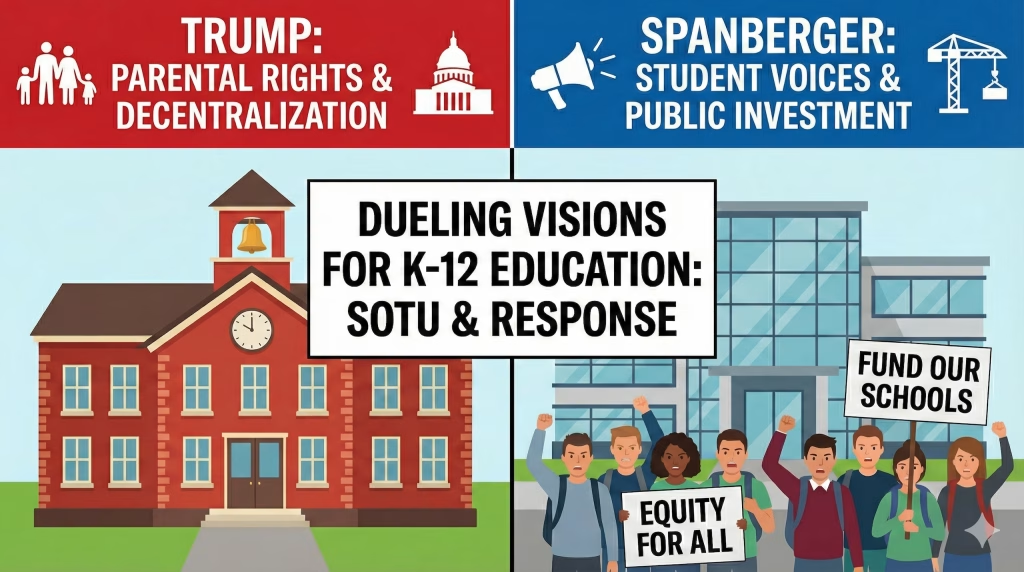
Last night’s State of the Union address and the Democratic rebuttal from Virginia Governor Abigail Spanberger offered the nation two starkly contrasting visions for K-12 education. President Trump touted his administration’s record on parental rights and devolving authority to states, while Governor Spanberger argued for a renewed focus on student activism and traditional school district funding.
Trump: Defend Parents’ Rights, Return Power to States
In last night’s address, Trump framed his education agenda around giving families more control over their children’s education and moral formation. This message was dramatically highlighted by the attendance of Sage Blair, a Virginia teenager, and her mother, Michelle, as the President’s guests.
Sage Blair’s story, which involves a lawsuit against her former school district alleging that officials began her “social transition” without her parents’ knowledge or consent, has fueled the national debate over gender ideology. Trump cited her experience to underscore his administration’s commitment to policies that would require parental notification and consent for any actions related to a student’s gender identity.
“They’re not even telling the parents,” Trump said last night. “But surely we can all agree no state can be allowed to rip children from their parents’ arms and transition them to a new gender against the parents’ will.”
Looking towards the future, Trump stressed a need to modernize the nation’s K-12 curricula. Everest Nevraumont, a student from Texas’s AI-driven Alpha School, was recognized for her engagement with cutting-edge technology. Nevraumont’s attendance highlighted the administration’s view that artificial intelligence can be thoughtfully integrated with a modern education.
While not directly addressed in last night’s State of the Union, the administration has redoubled its efforts to downsize the federal role in K-12 education. “As we continue to break up the federal education bureaucracy and return education to the states, our new partnerships with the State Department and HHS represent a practical step toward greater efficiency, stronger coordination, and meaningful improvement,” U.S. Secretary of Education Linda McMahon said on Monday.
In a statement issued last night, McMahon called Trump’s address “powerful and forward-looking,” adding the administration will “ensure every student has the chance to succeed and every family has a voice in their child’s education.”
Spanberger: Affirm Student Voices, Fund Public Schools
Giving the Democratic rebuttal from Colonial Williamsburg, Spanberger offered a stark contrast from the President’s educational priorities. The governor lauded students who organized the anti-ICE school walkouts in recent months. She rejected legislative efforts to curb the promulgation of leftism in public education, framing them as calls to “silence” the voices of students. In Spanberger’s view, the administration’s focus on combating leftist ideology has distracted officials from the actual needs of educators and families.
While not mentioned during her rebuttal, Spanberger has made public spending on education a signature issue, calling for high-dollar investments in school infrastructure and higher teacher salaries. In her own inaugural address, Spanberger accused the federal government of “gilding buildings while schools crumble.” Last night, she echoed this sentiment, lambasting the White House for “cutting food programs for hungry kids” in favor of vanity projects while the cost of living soars.
A Contentious Debate
Last night’s speeches underscored a fundamental clash of visions for the American classroom. Moving forward, the national education debate will increasingly revolve around two distinct frameworks: one that enshrines parental rights while harnessing innovation from outside government, and one that favors left-coded social justice initiatives and robust spending on governmental systems. These rival worldviews, in the context of issues ranging from school athletics to the use of federal scholarship tax credits, will likely dominate the educational policy landscape for the remainder of this year.