
Local Educators Share Practical Advice for Parents
EdNews Virginia | March 13, 2026
ARLINGTON, VA — While advocates called for “universal school choice,” many families gathered in Arlington last Saturday were looking for immediate solutions within the often-frustrating confines of Virginia’s current educational reality.
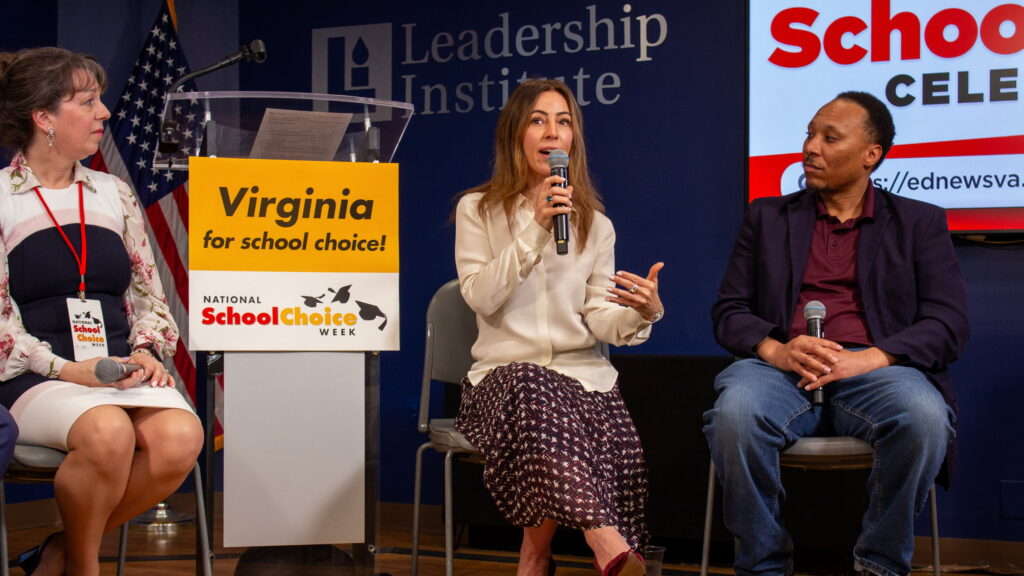
“What we wanted to do here at EdReform Virginia is to talk about specifics,” said moderator Steven Mosley. To provide that clarity, the organization’s fourth annual school choice event featured a panel of three veteran educators who already have built viable alternatives to the conventional “one-size-fits-all” model.
1. The Classical Microschool: ‘Content-Rich Instruction’
Dr. Jaime Osborne, a teacher with 25 years of experience and three degrees in education, founded Northern Virginia Classical Academy after growing disillusioned with the “lack of content-rich instruction” in public, government-run schools.
“Kids are being taught by the laptops or the Chromebooks,” Osborne observed. “There is an impetus in the classroom from the teacher teaching the students to more of the students teaching each other and also using screens to almost replace the teacher.”
Her solution is a classical microschool model. For parents worried about the “how,” Osborne explained that in Virginia, a microschool operates in the “homeschooling box,” where families submit a notice of intent to the local school division, while she provides the licensed instruction and curriculum.
2. Homeschooling: Reclaiming the Moral Foundation
Maria Keffler, co-founder of the Arlington Parent Coalition, shared her journey of pulling her three children from Arlington Public Schools in 2019 after witnessing a “horrifying” shift away from parental rights.
“The director of counseling for Arlington Public Schools said it’s the school’s job to ‘help parents along’ if they’re not on board with gender ideology yet — and kids need to be ‘protected’ from their parents,” Keffler recalled.
Keffler, a licensed teacher herself, emphasized that homeschooling allows families to set a moral compass for their own children.
“If you don’t have an agreed-upon moral foundation, what happens? You become your own authority… Everybody’s the high priest of their own religion,” Keffler said. For those ready to begin their home-based education journey, she urged families to visit HEAV.org and HSLDA.org — both websites offer a wealth of information and guidance.
3. The Socratic Seminar: Learning How to Disagree
Dr. Andrew Shivone, president of the St. Jerome Institute, highlighted a model focused on “reason and virtue” through the Socratic seminar. In this environment, the “sage on the stage” is replaced by a circle of students discussing primary sources like The Odyssey.
A seminar teacher will propose a topic for discussion “and then he doesn’t talk,” Shivone explained. This method forces students “to do the thinking and the learning.”
Shivone argued this educational style does more than just raise test scores; it mends our civic fabric by teaching students how to argue without demonization. “This teaches them how to have a debate without it becoming ‘I hate you, you’re evil.’ Our students are really, really comfortable being disagreeable.”
The Final Word: Find Your Community
The panel concluded with a unanimous piece of advice: Do not do this alone. Whether it is a parochial school, a classical academy, or a local homeschool “co-op,” the key to a successful transition is a support network. Shivone urged families “to try to find a community of other parents who can support you and help you.”
Watch the Full Panel Discussion
For a deeper dive into standardized test score data, specific educational options and more personal stories from the panelists, watch the full session below: